How Singapore Law Deals With Scam-Related Fraud
Scams have become increasingly sophisticated in Singapore, ranging from online investment scams and phishing schemes to e-commerce scams, impersonation scams and schemes involving money mules.
From a criminal lawyer perspective, however, a “scam” is not itself a single offence. Depending on how the scheme was carried out and the role played by the accused, the conduct may give rise to charges under the Penal Code 1871, the Corruption, Drug Trafficking and Other Serious Crimes (Confiscation of Benefits) Act 1992 (CDSA), the Computer Misuse Act 1993, or other legislation.
The consequences can be serious. A person who facilitates the movement of scam proceeds, provides access to a bank account, supplies credentials or otherwise assists a scam operation may potentially face criminal liability even if that person was not the individual who directly communicated with or deceived the victim.
This article explains how Singapore law approaches scam-related fraud and some of the key offences that may arise.
Law stated as at 15 September 2026.

What Is Considered a Scam-Related Offence in Singapore?
A scam generally involves deception intended to cause another person to act, or refrain from acting, in a way that results in loss, wrongful gain or other harm.
The legal characterisation of the conduct depends on the specific facts.
For example:
- A person may falsely represent themselves as a bank officer and persuade a victim to transfer money.
- An individual may advertise goods online that do not exist and induce buyers to make payment.
- A person may impersonate a government official and pressure a victim into transferring funds.
- Someone may allow their bank account to receive and transfer criminal proceeds.
- An individual may provide banking, Singpass or other access credentials to another person.
- A person may assist in transferring or withdrawing funds linked to scam activity.
These scenarios can potentially involve different criminal offences.
Recent Singapore Police Force investigations into scam-related activities have involved offences including cheating, money laundering, computer-related offences and providing payment services without a licence.
The appropriate charge depends on what the accused actually did, what they knew or had reason to believe, and the statutory requirements of the particular offence.
1. Cheating Under Section 420 of the Penal Code
One of the principal offences that may arise in scam cases is cheating under Section 420 of the Penal Code.
Section 415 sets out the concept of cheating. Broadly, a person may commit cheating where, by deception, they fraudulently or dishonestly induce another person to deliver property, allow property to be retained, or do or omit something which they would not otherwise have done or omitted, resulting in or being likely to result in harm.
Section 420 applies where the cheating dishonestly induces the person deceived to deliver, or cause the delivery of, property or to deal with certain forms of valuable security.
Under the current law, an offence under Section 420(1) carries imprisonment of up to 10 years, and the offender is also liable to a fine, caning, or both.
Cheating by remote communication
Singapore law also specifically addresses cheating carried out through remote communication.
This is particularly relevant to modern scams conducted through:
- WhatsApp or other messaging applications;
- telephone calls;
- email;
- social media;
- websites;
- online platforms; and
- other forms of electronic communication.
Section 420(2) provides for cheating by remote communication where the conduct dishonestly induces the acts described in Section 420(1).
The offence carries imprisonment of up to 10 years and caning of not less than six strokes, and the offender is also liable to a fine.
The general legal rules governing whether a particular offender may be caned continue to apply.
The distinction is significant because many modern scams are conducted entirely online or over the telephone, without the offender ever meeting the victim personally.
2. Fraud by False Representation, Non-Disclosure or Abuse of Position
The Penal Code also contains specific offences concerning fraudulent or dishonest conduct involving false representations, non-disclosure and abuse of position.
Section 424A
Section 424A applies where a person fraudulently or dishonestly:
- makes a false representation;
- fails to disclose information which they are under a legal duty to disclose; or
- abuses a position which they occupy in which they are expected to safeguard, or not act against, another person’s financial interests.
However, an important qualification applies.
Section 424A does not apply where the false representation, failure to disclose or abuse of position is directly connected with a written or oral contract for the supply of goods or services.
An offence under Section 424A can carry imprisonment of up to 20 years, a fine, or both.
Section 424B
Section 424B creates a related offence involving fraudulent or dishonest false representation, non-disclosure or abuse of position.
Section 424B does not apply to conduct that would constitute an offence under Section 424A.
The distinction between Sections 424A and 424B may therefore depend on the nature of the transaction and, among other matters, whether the conduct is directly connected with a contract for the supply of goods or services.
Section 424B likewise carries imprisonment of up to 20 years, a fine, or both.
These provisions demonstrate why it should not be assumed that every scam-related case will simply result in a Section 420 charge.
The precise conduct, the relationship between the parties and the circumstances of the transaction may affect which offence is applicable.
3. Money Mules and the Movement of Scam Proceeds
A common misconception is that only the person who actually communicates with and deceives the victim can be criminally liable.
That is not necessarily the case.
Singapore authorities take a serious view of individuals who assist criminal syndicates by providing bank accounts, transferring funds, withdrawing money or otherwise facilitating the retention or movement of criminal proceeds.
The CDSA contains several offences concerning benefits derived from criminal conduct.
Section 51 of the CDSA
Section 51 deals with arrangements that assist another person to retain or control benefits from criminal conduct in circumstances where the required knowledge or reasonable grounds to believe are established.
Depending on the facts, this may become relevant where a person knowingly or in circumstances giving rise to the required state of mind assists another person in retaining, controlling or dealing with criminal proceeds.
Section 55A of the CDSA
Section 55A addresses certain arrangements and dealings involving benefits from criminal conduct, including circumstances involving payment accounts.
Among other situations, the legislation addresses circumstances where a person:
- enables another person to access, operate or control a payment account and fails to take reasonable steps to ascertain the purpose of doing so;
- receives money in, or transfers money from, a payment account and fails to take reasonable steps to ascertain the source or destination of the money; or
- receives or transfers property and fails to take reasonable steps to ascertain the identity and physical location of the relevant person.
For an individual convicted of an offence under Section 55A(1) or Section 55A(2), the maximum punishment is currently a fine of $50,000, imprisonment of up to three years, or both.
Recent Police cases illustrate how money-mule investigations may involve people who allegedly:
- surrender or sell their bank accounts;
- provide Internet banking credentials;
- allow their accounts to receive scam proceeds;
- transfer money for other individuals;
- withdraw money received into their accounts;
- provide Singpass or other credentials; or
- otherwise facilitate criminal syndicates.
In April 2026, for example, the Singapore Police Force announced charges against 20 persons suspected of involvement in scam-related money-mule activities. The alleged offences included abetment to cheating, assisting another to retain benefits from criminal conduct and abetting unauthorised access to computer material.
Recent High Court Guidance on Sentencing for Money Mules
The High Court recently provided important sentencing guidance for scam-related offences in Mohamed Erzan Taib Zohri v Public Prosecutor and other appeals [2026] SGHC 183, decided on 10 September 2026.
Among other issues, the Court considered the appropriate sentence for an offender who relinquishes control of a bank account in circumstances amounting to an offence under Section 55A(1) of the CDSA.
For an archetypal case of bank account relinquishment under Section 55A(1), the High Court held that the benchmark sentence is six months’ imprisonment for a first-time offender convicted after trial.
Importantly, the Court regarded an offender who relinquishes a bank account for financial gain as falling within the archetypal case. Financial gain should therefore not, without more, be treated as a separate aggravating factor on top of the six-month benchmark. The eventual sentence may nevertheless be increased or reduced depending on the aggravating and mitigating circumstances of the particular case. Relevant factors may include, among other matters, the amount of criminal proceeds flowing through the account and the vulnerability of the scam victims.
The High Court also addressed the sentencing of young offenders involved in scam-related offences. It held that the commission of a scam-related offence does not, by itself, mean that imprisonment or reformative training should become the default sentence for a young offender. The established sentencing principles applicable to young offenders continue to apply, and rehabilitation remains the presumptive primary sentencing consideration unless the circumstances justify giving greater weight to other sentencing considerations.
Accordingly, describing an accused person simply as a “money mule” does not determine the eventual sentence. The precise offence charged, the manner and extent of the accused person’s involvement, the amount and movement of the criminal proceeds, the accused person’s culpability, any aggravating or mitigating factors and, where applicable, the accused person’s rehabilitative prospects must be considered.
“I didn’t know it was scam money” — is that a defence?
Knowledge and the circumstances in which the accused became involved can be highly important.
However, simply stating that a person “did not know” does not by itself determine whether there is criminal liability.
The legal test depends on the offence charged.
For example, Sections 55A(3) and 55A(4) provide statutory defences in relation to the corresponding Section 55A offences where the accused proves that they did not know and had no reasonable ground to believe that the relevant arrangement or property related to benefits from criminal conduct.
Other offences may contain different requirements concerning knowledge, belief, suspicion or reasonable grounds.
Evidence that may become relevant can include:
- communications between the parties;
- the circumstances in which the bank account was provided;
- the reason given for receiving or transferring funds;
- the amount and frequency of transactions;
- whether payment was offered for use of the account;
- whether warnings or suspicious circumstances were ignored; and
- the steps, if any, taken to understand the source or destination of the money.
A person whose bank account has been used to receive or transfer suspicious funds should therefore not assume either that liability automatically arises or that describing themselves as an innocent intermediary automatically resolves the matter.
The applicable offence and all the surrounding circumstances have to be considered.
Caning for scam-related offences
Singapore has strengthened the punishment available for scams and scam-related offences.
With effect from 30 December 2025, scammers and members or recruiters of scam syndicates may face mandatory caning of at least six strokes, with the applicable punishment depending on the offence and circumstances.
Certain scam-mule offences can also attract discretionary caning of up to 12 strokes, including specified money-laundering, Singpass and SIM-card related offences where the statutory requirements are satisfied.
Whether caning applies in an individual case depends on the precise charge, the facts and the general law governing caning.
4. Computer-Related Offences
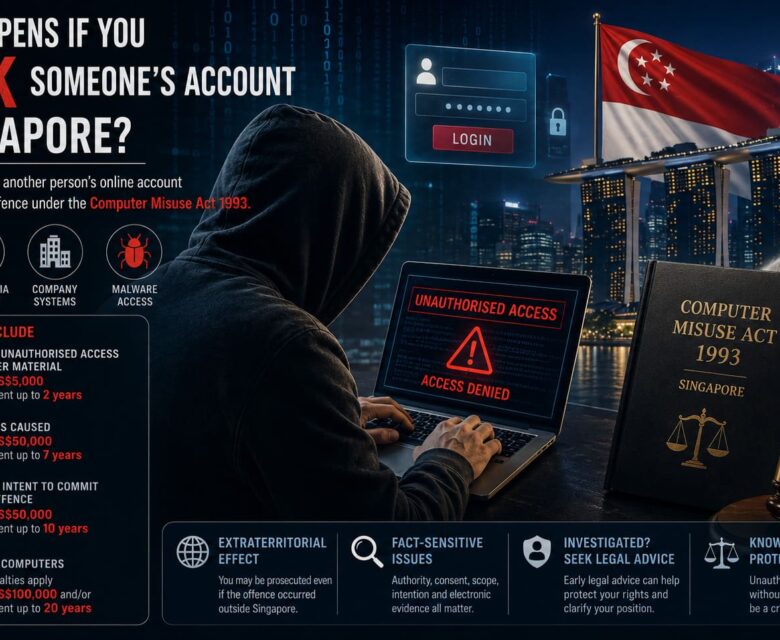
Scam investigations can also involve offences under the Computer Misuse Act 1993.
Section 3, for example, deals with unauthorised access to computer material.
Other provisions deal specifically with passwords, access codes and digital credentials.
Unauthorised disclosure of passwords or access codes
Section 8 concerns the unauthorised disclosure of a password, access code or other means of gaining access to computer data in specified circumstances, including where it is done for wrongful gain, an unlawful purpose or with the required knowledge concerning wrongful loss.
Singpass and national digital identity credentials
Section 8A deals specifically with the disclosure or provision of passwords, access codes or other means of securing access in relation to Singapore’s national digital identity service.
Section 8B separately addresses obtaining, retaining, supplying or making available another person’s national digital identity credentials in circumstances covered by the legislation.
These provisions can become particularly relevant where scams involve:
- compromised online accounts;
- Singpass credentials;
- Internet banking credentials;
- unauthorised access to banking or other systems;
- stolen passwords;
- digital identity misuse; or
- access provided to criminal syndicates.
A single scam investigation may therefore give rise to multiple charges arising from the same overall scheme, rather than only a cheating charge.
5. Abetment and Conspiracy
A person does not necessarily have to be the “main scammer” to face criminal liability.
Depending on the evidence, a person may be investigated or charged for matters including:
- abetting cheating;
- criminal conspiracy;
- facilitating unauthorised access to computer material;
- unlawfully supplying credentials;
- assisting with the retention or movement of criminal proceeds; or
- other acts that facilitate the underlying offence.
This is particularly significant in organised scam operations, where different individuals may perform different functions.
For example, one person may contact victims, another may provide bank accounts, another may receive funds, and another may transfer or withdraw the money.
The fact that an individual performed only one part of the overall operation does not, by itself, prevent criminal liability.
Whether liability arises depends on the elements of the relevant offence and the evidence concerning that person’s conduct and state of mind.
6. What Happens to Money Obtained Through a Scam?
Singapore law does not only focus on the initial deception of the victim.
The authorities may also investigate the proceeds of criminal conduct and what happened to the money after it left the victim’s possession.
The CDSA contains provisions concerning arrangements involving criminal proceeds and the acquisition, possession, use, concealment, conversion or transfer of benefits from criminal conduct.
This means that an investigation may follow the movement of money through multiple accounts and individuals.
For example:
Victim → Scammer → Bank Account → Money Mule → Other Account → Cash Withdrawal
Each stage may become relevant to the investigation.
Investigators may examine who controlled each account, who authorised the transactions, what instructions were given, what each participant knew, and why the money was transferred or withdrawn.
This is one reason individuals who allow their accounts to be used by others can face serious consequences even if they did not personally communicate with the original victim.
7. How Does the Court Assess a Scam-Related Criminal Case?
The outcome of a criminal case depends on the specific facts, the charge brought and the evidence available.
Issues that may become important include:
The accused person’s role
The court may consider whether the accused was:
- the principal offender;
- an organiser;
- a recruiter;
- an active participant;
- a money mule;
- an account holder;
- a person who assisted another individual; or
- someone whose involvement was more limited.
The accused person’s knowledge and intention
Depending on the offence, the prosecution may rely on communications, bank transactions, messages, call records and other evidence to establish what the accused knew, believed or intended.
The relevant legal state of mind depends on the particular offence charged.
The amount of money involved
The amount involved may be an important consideration, including at the sentencing stage, although it is not necessarily the only relevant factor.
The number of victims and transactions
A case involving multiple victims or repeated transactions may be treated differently from an isolated incident.
The duration and sophistication of the offending may also be relevant.
The accused person’s personal circumstances
Depending on the offence and applicable sentencing framework, the court may take into account relevant mitigating and personal circumstances.
These may include matters such as the offender’s role, level of involvement, cooperation with the authorities, plea of guilt and other legally relevant circumstances.
8. Scam Investigations Can Involve Extensive Financial and Digital Evidence
Scam-related cases frequently involve financial transactions and digital evidence.
Investigators may examine:
- bank account records;
- transaction histories;
- mobile phones;
- WhatsApp or other messaging records;
- email accounts;
- Internet banking activity;
- IP addresses or device information;
- CCTV footage;
- Singpass or other digital credentials; and
- communications with other suspects.
The fact that a person’s bank account appears somewhere in a chain of transactions does not, by itself, determine that person’s criminal liability.
Equally, a person may potentially face liability even where they did not personally receive the victim’s money.
The surrounding circumstances, the person’s actual role, the applicable statutory provision and the evidence concerning their state of mind can all be critical.
9. Singapore’s Approach Is Increasingly Focused on Scam Prevention
Singapore’s legal response to scams is not limited to prosecuting offenders after money has already been lost.
The Protection from Scams Act 2025 came into effect on 1 July 2025.
The Act empowers the Police, in specified circumstances, to issue Restriction Orders to banks to restrict the banking and credit facilities of individuals believed to be at risk of sending money to scammers.
A Restriction Order may be issued where the statutory requirements are satisfied and a Police officer has reasonable belief that the individual will:
- make a money transfer to a scammer;
- withdraw money with the intention of giving it to a scammer; or
- apply for or draw down on a credit facility with the intention of benefiting a scammer.
As of 15 February 2026, the Ministry of Home Affairs reported that 12 Restriction Orders had been issued.
This preventive framework reflects Singapore’s broader approach to scams: preventing losses where possible, disrupting criminal networks, restricting the movement of illicit funds and prosecuting persons involved in scam-related offences.
What Should You Do If You Are Being Investigated for a Scam-Related Offence?
If you have been contacted by the Police or are being investigated in connection with a scam, it is important to understand the nature of the allegation and the offence being investigated before making assumptions about your legal position.
You may wish to obtain legal advice if:
- your bank account was used to receive money for someone else;
- you transferred money on behalf of another person;
- you provided your banking credentials or account access;
- you provided your Singpass or other digital credentials;
- you received money which you later discovered may have originated from a scam;
- you are accused of helping a scam syndicate;
- your phone, computer or other device has been seized;
- you have been asked to assist with a Police investigation; or
- you have been informed that you may be charged.
Do not assume that being described as a “money mule” automatically determines your criminal liability.
Equally, do not assume that being only an intermediary means that you cannot be charged.
The precise facts, your role, what you knew or had reason to believe, your communications with other parties, the steps you took and the particular statutory provisions involved can all be relevant.
Frequently Asked Questions
Is scamming a criminal offence in Singapore?
Scam-related conduct can constitute a number of different criminal offences in Singapore.
Depending on the circumstances, these can include cheating, fraud-related offences, money-laundering or criminal-proceeds offences, computer-related offences, abetment and criminal conspiracy.
There is no single offence that covers every form of conduct commonly described as a “scam”.
What is the punishment for cheating in Singapore?
For cheating falling within Section 420(1) of the Penal Code, the maximum imprisonment term is currently 10 years, and the offender is also liable to a fine, caning, or both.
For cheating by remote communication under Section 420(2), the offence carries imprisonment of up to 10 years and caning of not less than six strokes, and the offender is also liable to a fine.
The applicability of caning in an individual case remains subject to the general law governing caning.
Can a money mule be charged even if they did not scam the victim?
Yes.
A person may potentially face criminal liability even if they were not the individual who directly deceived or communicated with the victim.
Depending on the facts, offences may arise from dealing with criminal proceeds, facilitating an arrangement involving such proceeds, providing bank or digital credentials, abetting another offence or participating in a conspiracy.
What if I allowed someone to use my bank account?
Allowing another person to access or use your bank account can create significant legal risk, particularly where the account is subsequently used to receive or transfer criminal proceeds.
The circumstances surrounding the arrangement, what you knew or had reason to believe, why access was provided, whether you received any benefit and what reasonable steps you took can all be relevant.
Section 55A of the CDSA specifically addresses certain circumstances involving access to payment accounts and failures to take reasonable steps to ascertain matters such as the purpose, source or destination of funds.
What if I gave someone my Singpass credentials?
Providing Singpass or other national digital identity credentials may potentially engage provisions of the Computer Misuse Act, depending on the circumstances and purpose for which the credentials were provided or used.
A person should not assume that liability arises only where they personally use the credentials to commit the underlying scam.
Does receiving scam money automatically make someone guilty?
Not necessarily.
The mere receipt of money does not by itself determine criminal liability.
The prosecution must establish the elements of the particular offence charged, subject to any applicable statutory presumptions, evidential provisions or defences.
However, receiving or transferring suspicious funds can lead to investigation, particularly where the circumstances suggest that the person failed to make reasonable enquiries or was otherwise involved in facilitating the movement of criminal proceeds.
Can scam-related offences result in caning?
Yes, in certain circumstances.
Following legislative changes that took effect on 30 December 2025, scammers and certain persons involved in scam syndicates may face mandatory caning, while certain scam-mule offences may attract discretionary caning.
Whether caning applies depends on the specific offence, the statutory conditions and the general law governing caning.
Conclusion
Singapore takes scam-related fraud seriously, and criminal liability can extend beyond the individual who directly deceived the victim.
Depending on the circumstances, a scam investigation may involve cheating under the Penal Code, fraud-related offences, money-laundering or criminal-proceeds offences under the CDSA, offences under the Computer Misuse Act, and liability for abetment or conspiracy.
Recent legislative changes have also increased the potential consequences for persons involved in scams and scam-related activities.
For a person under investigation, one of the most important questions is therefore not simply whether money passed through their hands or bank account.
The law may also examine what role they played, what they knew or had reason to believe, what they intended, what steps they took, and what they did in relation to the alleged scam.
If you are being investigated or charged in connection with a scam, money-mule activity, alleged cheating or suspected handling of criminal proceeds, obtaining experienced criminal lawyer advice at an early stage can help you understand the allegations, the potential offences involved and the legal issues arising from your particular circumstances.
This article is for general information only and does not constitute legal advice. The applicable law, available defences and sentencing position depend on the facts of each case and may change over time.